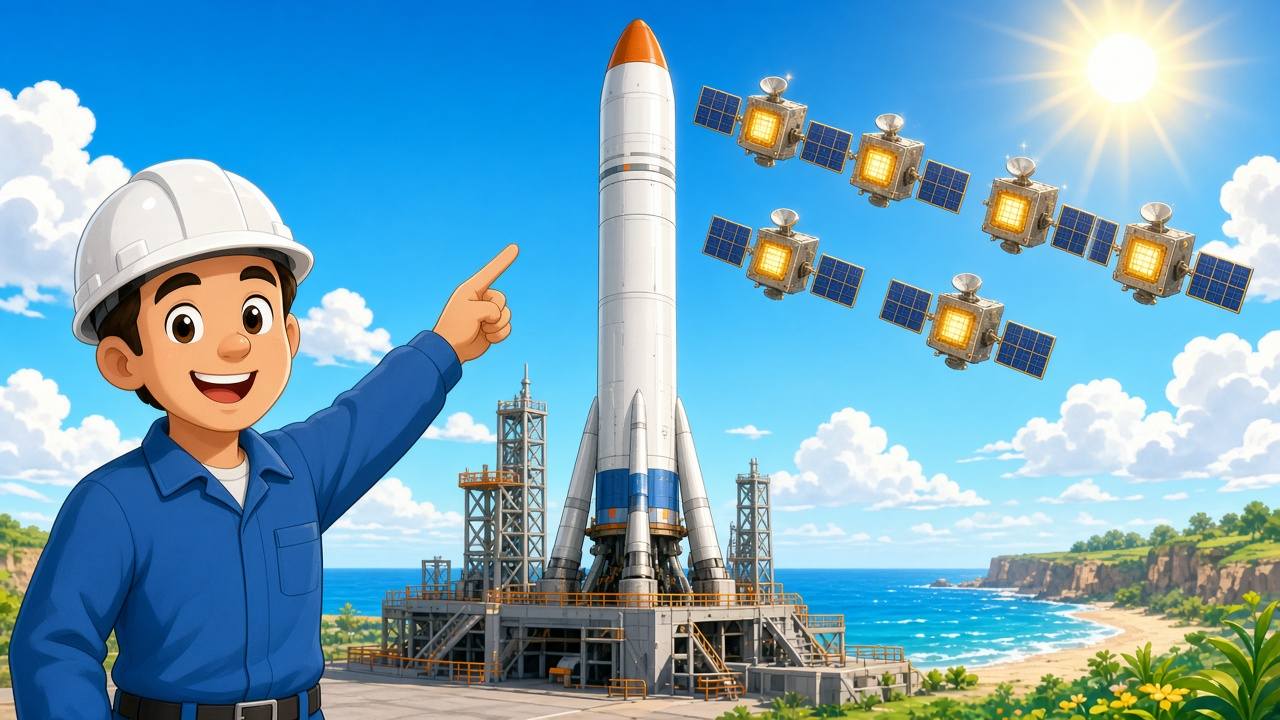
Google’s experimental satellite for Project Suncatcher has done something no machine had done before: it ran a data-center-class AI chip in orbit, answered a prompt from the ground and sent the result home. The answer was not a spreadsheet or a weather forecast but a tiny poem. “Blue marble below / Data streams in silent grace / Starlight feeds my core,” the onboard model wrote, and the words reached Earth as the satellite passed over Svalbard in Norway.
Travis Beals, senior director of Google’s Paradigms of Intelligence research team, announced the milestone in a blog post on Friday, October 30. He called it the project’s “Hello World” moment, borrowing the phrase programmers use for the very first output of a new system. It is a small step in practical terms, but it marks the first time a Tensor Processing Unit, the custom chip Google uses to train and run its AI models in large data centers, has completed real inference work in space.
The satellite was built together with Planet, the Earth-imaging company, and launched on October 1 aboard SpaceX’s Transporter-18 rideshare mission. Since then, the team has worked through a commissioning checklist that took about three weeks. It powered up the host computer and the trays holding the TPUs, ran early machine learning tests and confirmed that the spacecraft was operating normally before attempting the first live prompt.
The prompt itself was playful. According to The Register, engineers asked the model to “write a haiku from the perspective of a TPU orbiting Earth, with the wonderful world spinning beneath you.” The model doing the writing was Gemma 4, Google’s open AI model, which runs locally on the satellite rather than on a server on the ground. After the haiku, the team tried space-themed limericks and prompts that asked the satellite to report on the technical status of its own payload.
The hardware has clear limits. The satellite carries four TPUs but can generate only up to about one kilowatt of power, according to reporting by TechCrunch. That means it can run just one of the chips at a time, for roughly 20 minutes. Omar Sanseviero, who works on Gemma at Google DeepMind, noted on X that the model ran on stored solar energy, which is exactly the resource the whole project hopes to exploit at much larger scale.
Why Google wants to put AI data centers in orbit
The idea behind Project Suncatcher sounds like science fiction, but the motivation is down to earth. Artificial intelligence is consuming electricity at an extraordinary pace. New data centers need huge amounts of power, cooling water and land, and in many regions they are straining local grids and drawing opposition from residents. In orbit, by contrast, solar panels can receive sunlight almost continuously, without clouds, night-time gaps or seasonal weather, and the energy does not have to be bought from a utility.
Google laid out the research behind the mission in a peer-reviewed paper published in the journal Joule. Its central argument is economic. Today, launching hardware is far too expensive for orbital computing to compete with data centers on the ground. But Google’s calculations suggest that if the cost of reaching low Earth orbit falls to around 200 dollars per kilogram, the launch cost spread over a satellite’s useful life could be comparable to what US data centers currently spend on electricity per kilowatt each year. The company expects launch prices could reach that level around the middle of the next decade, and it considers it smart to start building prototypes long before that happens.
The Register put the current reality in perspective with a little arithmetic. The roughly 20 tokens of the haiku would cost a tiny fraction of a cent through Google’s cloud service. Generated in orbit, on a satellite that had to be built and launched, they are probably among the most expensive words ever produced by an AI. That is the nature of a first prototype: it is meant to prove that something works, not that it is already cheap.
Several big technical questions remain. Space is a hostile environment for electronics. High-energy particles can flip bits in a chip’s memory and corrupt data without warning, and heat cannot simply be blown away by fans because there is no air to carry it. Google has already tested its Trillium TPUs and an AMD host server in the laboratory by firing a 67 MeV proton beam at them. The most sensitive component turned out to be the high-bandwidth memory, which began showing irregularities only after a cumulative radiation dose of about three times the minimum Google requires for the mission. Ground tests also suggested that occasional errors matter less when a model is answering questions than when it is being trained.
That is why the next phase of the mission focuses on stress testing. “Next, we will continue with a series of tests to evaluate how TPUs perform under thermal stress and radiation exposure in orbit,” Beals wrote. If the chips can reliably handle workloads under those conditions, Google plans to move on to its next milestone in 2027: two satellites that are linked to each other. Connecting satellites with fast optical links is essential to the long-term vision, because a real orbital data center would be a swarm of spacecraft working together, sharing data as if they were racks in the same building.
Google is not alone in looking up. Several companies and start-ups are exploring computing in space, and the topic has become a talking point as the AI industry searches for new sources of energy. What makes Suncatcher stand out is that a major AI company has put its own production-class chips into orbit and shown them doing useful work, however modest. Critics point out that the business case still depends on launch costs falling dramatically and on hardware surviving for years in a harsh environment. Supporters answer that every large infrastructure shift started with demonstrations that looked impractical at first.
For now, the satellite continues to circle the planet, running its chips in short bursts whenever its batteries allow. Its first message may be only three lines long, yet it captures the project’s ambition rather neatly. In Beals’ words, Google’s chips “have officially earned their space wings,” and the long road toward data centers powered directly by the Sun has its first verse.