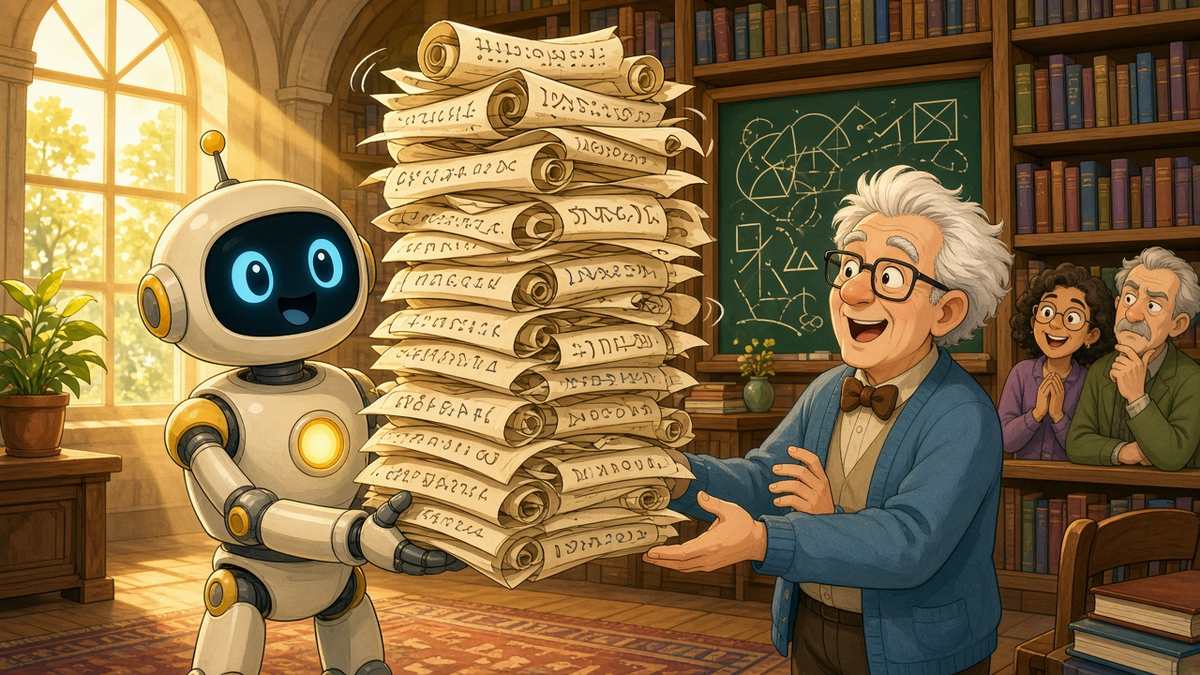
Mathematics has seen breakthroughs before, but rarely has a single week delivered them by the hundred. On Tuesday evening, OpenAI uploaded 722 AI-written mathematical manuscripts to a public GitHub repository, grouped into 372 families of results. The company says each one either resolves or makes substantial progress on an open question in mathematics or theoretical computer science. Nearly all of the work was produced by an unreleased internal model that OpenAI has not named.
The scale is what has stunned the field. According to the company, the model was handed roughly 4,000 problems and spent about three hours of computing time on each result it found. The batch includes what OpenAI calls a “quasi-Riemann hypothesis”, a weaker cousin of the famous Riemann hypothesis, which itself remains unproven. OpenAI also says it made progress on three Millennium Prize problems without fully solving any of them. That claim follows only weeks after the company announced that the same internal system had cracked the Navier-Stokes equations, another of the seven problems for which the Clay Mathematics Institute offers a one-million-dollar prize.
Mathematicians now face a mountain of paper. Scientific American described the release as a deluge that will take months to parse, both to confirm that the proofs are correct and to judge whether they contain genuinely new ideas or are mostly clever recombinations of known techniques. By the repository’s own count, the main results of 162 papers have been formally verified in Lean, a proof assistant that checks every logical step by computer. A Lean-verified result is all but certain to be correct. The remaining papers, however, are for now unreviewed claims, and OpenAI concedes that some of them “could have issues”, promising to correct errors quickly as they are reported.
Early spot checks paint a mixed picture. Kevin Buzzard of Imperial College London told New Scientist that around 30 of the papers touched his own field of number theory, but that only seven of them struck him as impressive and only one had been formally verified. Others are more enthusiastic. Daniel Litt, a mathematician at the University of Toronto, said several of the published solutions affect problems he cares about personally. “My view is that this is great for mathematics,” he told Fortune, adding that he saw no reason why a company should keep answers to mathematical questions secret from the people who want to know them.
A field divided over how progress should look
The argument is less about whether the proofs are right than about what this way of doing mathematics means for the discipline. Terence Tao of UCLA, a Fields Medalist and one of the most respected living mathematicians, has become a leading critic of how AI companies pursue famous open problems. In a post on Mastodon he warned that problems are now “being solved autonomously by AI prompters who have no interest in the broader field itself once their initial target is ‘solved'”, and who often cannot answer questions about the result, give talks on it or connect it to related work. Traditional breakthroughs, he argued, used to spark seminars, collaborations and new research communities; machine-made results produce far fewer of those ripples.
Tao described the moment as the end of what he calls “Math 1.0”, an era in which solving long-standing conjectures was the engine of the field. A “Math 2.0”, in his view, will have to value exposition, community building and the opening of new directions as much as raw problem-solving. Litt agrees that the discipline must change, from how it rewards contributions to how it trains doctoral students, but he sounds far more optimistic about it. He quoted a collaborator who told him: “I feel like I’ve been crawling my entire life, and now I can fly.” Litt expects AI to free human mathematicians for much more open-ended exploration, while warning that society must not use the perception that AI has “solved math” as an excuse to cut funding for human expertise.
There is also a quarrel over process. After the Navier-Stokes announcement, two mathematicians who had been attacking the same problem with AI tools accused OpenAI of drawing, intentionally or not, on their unfinished work. The company denied it. In response to the new release, Tristan Buckmaster of New York University, one of the two, told the New York Times that he doubted OpenAI had done proper due diligence to make sure its model was not completing other people’s research.
Following that dispute, OpenAI helped set up an independent Advisory Group on Mathematics and Artificial Intelligence, hosted at the Institute for Advanced Study in Princeton. Late last month the group published recommendations for releasing AI-generated proofs: write them up like conventional research papers, disclose the model, the prompts, the reasoning trace, the computing time and its approximate cost, explain why particular problems were chosen and report how many comparable problems the system tried and failed to solve. Observers note that OpenAI followed some of these steps but not all. The company says it “drew on” the advice, shared formal proofs for many results and, for ten problems, published reasoning summaries, compute estimates and statistics on attempted problems. It has pledged to improve citations and exposition in future releases and to fund workshops and conferences that help mathematicians digest the results.
The advisory group’s own statement struck a cautious note. The future of mathematical research, it wrote, cannot consist only of understanding results produced by AI labs; mathematicians must remain free to formulate their own questions and pursue directions that were never chosen to show off a system’s capabilities. Fair access to powerful research tools and computing power, it added, is essential to that freedom. Others were blunter. A statement from a group calling itself the Association for Human Mathematics, posted on Tao’s blog, said that releasing more than 700 files at once “is not a demonstration of scholarship, but a demonstration of power”, and urged colleagues to stop working with OpenAI.
What is beyond dispute is that the workload for the mathematical community has just multiplied. Over the coming months, specialists will comb through hundreds of manuscripts, translate machine output into human understanding and decide which results truly move their fields forward. Whether that turns out to be the dawn of a more productive, more exploratory mathematics or the slow erosion of a centuries-old human craft may depend less on the machines than on the choices that universities, funders and AI companies make next.