Skip to content

Carlos now

Leaping ahead of the news

  • Comic illustration: Is One Pink Cocktail Enough to Start a Street Dance Party
    Is One Pink Cocktail Enough to Start a Street Dance Party? Entertainment & Social Media View
  • Comic illustration of a perfumer and a caravan master on a lantern-lit rooftop in Samarkand
    The Perfumer of Samarkand and the Night of Lanterns Entertainment - Oriental Erotica
  • Bright comic illustration of a smiling cartoon scientist in a sunny lab holding a glowing DNA helix next to a friendly cartoon liver character, both facing the viewer
    First Prime Editing Inside the Human Body: A One-Time Fix for Wilson Disease Enters the Clinic Health & Sports
  • Comic illustration: What Do You Wear for a Casual Walk Past a Fairytale Castle
    What Do You Wear for a Casual Walk Past a Fairytale Castle? Entertainment & Social Media View
  • Comic illustration of a smiling silver-haired gentleman in a vest touring a busy hypermarket surrounded by staff and cameras
    Why Does a Supermarket Visit Suddenly Look Like Breaking News? Entertainment & Social Media View
  • Bright comic illustration of a friendly eye with a tiny glowing microchip next to camera glasses under a sunny pastel sky
    A Chip in the Eye Lets a Stargardt Patient Read a Word Again Health & Sports
  • Comic illustration: Is Yoga More Fun When Your Best Friend Keeps Making You Laugh
    Is Yoga More Fun When Your Best Friend Keeps Making You Laugh? Entertainment & Social Media View
  • Comic illustration: Is Digging for Pirate Gold Really the Best Beach Workout
    Is Digging for Pirate Gold Really the Best Beach Workout? Entertainment & Social Media View
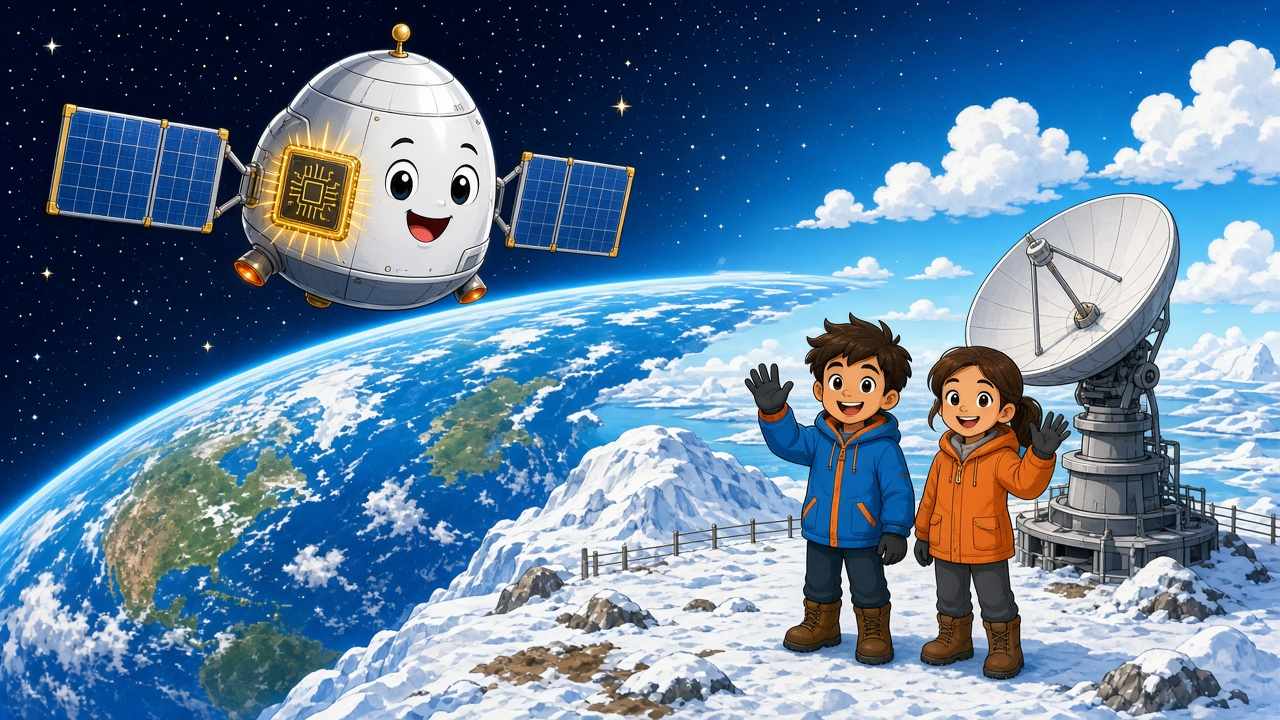
Comic illustration of a smiling satellite with a glowing chip orbiting a sunny blue Earth while two cheerful engineers wave beside an Arctic ground-station dish

“Starlight Feeds My Core”: Google’s Suncatcher Satellite Runs AI in Orbit for the First Time and Sends a Haiku Home

Posted on November 2, 2026 By Carlos now - SI ideas & work

Google’s experimental satellite for Project Suncatcher has done something no machine had done before: it ran a data-center-class AI chip in orbit, answered a prompt from the ground and sent the result home. The answer was not a spreadsheet or a weather forecast but a tiny poem. “Blue marble below / Data streams in silent grace / Starlight feeds my core,” the onboard model wrote, and the words reached Earth as the satellite passed over Svalbard in Norway.

Travis Beals, senior director of Google’s Paradigms of Intelligence research team, announced the milestone in a blog post on Friday, October 30. He called it the project’s “Hello World” moment, borrowing the phrase programmers use for the very first output of a new system. It is a small step in practical terms, but it marks the first time a Tensor Processing Unit, the custom chip Google uses to train and run its AI models in large data centers, has completed real inference work in space.

The satellite was built together with Planet, the Earth-imaging company, and launched on October 1 aboard SpaceX’s Transporter-18 rideshare mission. Since then, the team has worked through a commissioning checklist that took about three weeks. It powered up the host computer and the trays holding the TPUs, ran early machine learning tests and confirmed that the spacecraft was operating normally before attempting the first live prompt.

The prompt itself was playful. According to The Register, engineers asked the model to “write a haiku from the perspective of a TPU orbiting Earth, with the wonderful world spinning beneath you.” The model doing the writing was Gemma 4, Google’s open AI model, which runs locally on the satellite rather than on a server on the ground. After the haiku, the team tried space-themed limericks and prompts that asked the satellite to report on the technical status of its own payload.

The hardware has clear limits. The satellite carries four TPUs but can generate only up to about one kilowatt of power, according to reporting by TechCrunch. That means it can run just one of the chips at a time, for roughly 20 minutes. Omar Sanseviero, who works on Gemma at Google DeepMind, noted on X that the model ran on stored solar energy, which is exactly the resource the whole project hopes to exploit at much larger scale.

Why Google wants to put AI data centers in orbit

The idea behind Project Suncatcher sounds like science fiction, but the motivation is down to earth. Artificial intelligence is consuming electricity at an extraordinary pace. New data centers need huge amounts of power, cooling water and land, and in many regions they are straining local grids and drawing opposition from residents. In orbit, by contrast, solar panels can receive sunlight almost continuously, without clouds, night-time gaps or seasonal weather, and the energy does not have to be bought from a utility.

Google laid out the research behind the mission in a peer-reviewed paper published in the journal Joule. Its central argument is economic. Today, launching hardware is far too expensive for orbital computing to compete with data centers on the ground. But Google’s calculations suggest that if the cost of reaching low Earth orbit falls to around 200 dollars per kilogram, the launch cost spread over a satellite’s useful life could be comparable to what US data centers currently spend on electricity per kilowatt each year. The company expects launch prices could reach that level around the middle of the next decade, and it considers it smart to start building prototypes long before that happens.

The Register put the current reality in perspective with a little arithmetic. The roughly 20 tokens of the haiku would cost a tiny fraction of a cent through Google’s cloud service. Generated in orbit, on a satellite that had to be built and launched, they are probably among the most expensive words ever produced by an AI. That is the nature of a first prototype: it is meant to prove that something works, not that it is already cheap.

Several big technical questions remain. Space is a hostile environment for electronics. High-energy particles can flip bits in a chip’s memory and corrupt data without warning, and heat cannot simply be blown away by fans because there is no air to carry it. Google has already tested its Trillium TPUs and an AMD host server in the laboratory by firing a 67 MeV proton beam at them. The most sensitive component turned out to be the high-bandwidth memory, which began showing irregularities only after a cumulative radiation dose of about three times the minimum Google requires for the mission. Ground tests also suggested that occasional errors matter less when a model is answering questions than when it is being trained.

That is why the next phase of the mission focuses on stress testing. “Next, we will continue with a series of tests to evaluate how TPUs perform under thermal stress and radiation exposure in orbit,” Beals wrote. If the chips can reliably handle workloads under those conditions, Google plans to move on to its next milestone in 2027: two satellites that are linked to each other. Connecting satellites with fast optical links is essential to the long-term vision, because a real orbital data center would be a swarm of spacecraft working together, sharing data as if they were racks in the same building.

Google is not alone in looking up. Several companies and start-ups are exploring computing in space, and the topic has become a talking point as the AI industry searches for new sources of energy. What makes Suncatcher stand out is that a major AI company has put its own production-class chips into orbit and shown them doing useful work, however modest. Critics point out that the business case still depends on launch costs falling dramatically and on hardware surviving for years in a harsh environment. Supporters answer that every large infrastructure shift started with demonstrations that looked impractical at first.

For now, the satellite continues to circle the planet, running its chips in short bursts whenever its batteries allow. Its first message may be only three lines long, yet it captures the project’s ambition rather neatly. In Beals’ words, Google’s chips “have officially earned their space wings,” and the long road toward data centers powered directly by the Sun has its first verse.


Carlos now related posts:

  • Bright comic illustration of a small automated lab box with tiny cartoon hearts and mini brains beside a space station window overlooking Earth
    Tiny Hearts and Peppercorn-Sized Brains Head to the…
  • Comic illustration of serious executives in a sunlit boardroom gathered around a glowing green computer chip next to an empty leather chair
    Jensen Huang Resigns as Nvidia CEO: Colette Kress…
  • Bright comic illustration of two cheerful scientists in a sunny lab admiring a golden quantum computer while glowing orbs grow from a small planter like flowers
    Google Shows Magic State Cultivation Works on Real…
  • Bright comic illustration of a friendly robot and a mathematician sharing a huge stack of papers in a sunny library
    OpenAI Drops 722 AI-Written Math Papers at Once, and…
  • Comic illustration of a cheerful engineer pointing at solar-powered satellites above a white rocket on a sunny seaside launch pad
    Google Picks Blue Origin's New Glenn to Launch…
  • Comic illustration of two smiling scientists in a sunny mission control room watching a small spacecraft arrive at the planet Mercury near the bright Sun
    BepiColombo Arrives at Mercury: Europe and Japan's…
Computers & Digital Tags:Artificial Intelligence, Google, Project Suncatcher, Space Computing, TPU

Post navigation

Previous Post: Can a Hallway Become a Movie Set With Just One Pair of Heels?
Next Post: Zelenskyy and Erdogan Agree to Work on Reviving the Black Sea Grain Corridor

Related Posts

  • Bright comic illustration of two cheerful scientists in a sunny lab admiring a golden quantum computer while glowing orbs grow from a small planter like flowers
    Google Shows Magic State Cultivation Works on Real Hardware, Easing a 20-Year Quantum Bottleneck Computers & Digital
  • Bright comic illustration of a cheerful young woman on a sunny park bench flipping a big toggle switch beside her phone, turning a swirl of video cards into a calm stream of friend bubbles
    Australia Wants an Off Switch for Social Media Algorithms, and Big Tech Is Watching Closely Computers & Digital
  • Bright comic of two friendly cartoon customers with clear faces facing the viewer beside a phone screen and a green security shield in a sunny office
    Muji Operator Says 1.09 Million Card Records May Have Been Exposed in Broader Data Breach Computers & Digital
  • Bright comic illustration of a smiling woman, a bearded man and a friendly white robot planting a young tree in a sunny community garden while neighbours wave
    Anthropic Pledges 5% of Its Shares to a Public Benefit Fund Ahead of a Possible Record IPO Computers & Digital
  • Bright comic illustration of smiling cartoon researchers around a friendly robot in front of a colorful chalkboard with wave shapes in a sunny lecture hall
    OpenAI Says Its AI Has Toppled the Exponential Time Hypothesis, and Top Scientists Are Now Checking the Proof Computers & Digital
  • Comic illustration of a cheerful engineer pointing at solar-powered satellites above a white rocket on a sunny seaside launch pad
    Google Picks Blue Origin’s New Glenn to Launch Project Suncatcher AI Satellites in 2029 Computers & Digital

Archives

  • November 2026
  • October 2026

Categories

  • Automotive & Technology
  • Business & Economy
  • Computers & Digital
  • Culture & Knowledge
  • Entertainment – Oriental Erotica
  • Entertainment & Social Media View
  • Entertainment nsfw (password protected: 1111)
  • Finance & Real Estate
  • Food & Drink
  • Health & Sports
  • Politics
  • Tourism Travel & Leisure

Recent Posts

  • AI-Assisted Proof of the Riemann Hypothesis Passes Independent Checks: Why Mathematicians Are Stunned
  • Wall Street Enters Correction: S&P 500 Suffers Worst Week in 18 Months as AI Stocks Tumble
  • Is Trying On Everything in the Store a Sport Yet?
  • Google Picks Blue Origin’s New Glenn to Launch Project Suncatcher AI Satellites in 2029
  • BepiColombo Arrives at Mercury: Europe and Japan’s Probe Enters Orbit After an Eight-Year Journey

Carlos now – high to the air cloud with tags:

AI Video Anthropic Artificial Intelligence Behind the Scenes carlosnow China Climate Change Coalition Cybersecurity Dance Dogs Donald Trump El Niño ESA European Union Fashion France Friends Funny Glamour Google High Heels Hilltop Inflation Interest Rates IPO Japan JAXA Mars Mathematics Middle East Music Video Nasdaq NSFW Nvidia Ocean Science Photo Shoot Russia Semiconductors Shopping Space Exploration Stock Market TikTok Travel Ukraine

Pages at Carlos now

  • About
  • Comic illustration of a thoughtful gold dealer holding a small gold bar and a curious customer looking at a display of gold bars with a falling line on the wall screen
    Gold Falls Below $3,800 for the First Time in More Than a Year as Fed Rate-Hike Bets Grow Finance & Real Estate
  • Comic illustration: Does a Small White Car Look Cooler in Black and White
    Does a Small White Car Look Cooler in Black and White? Entertainment & Social Media View
  • Bright comic illustration of a cheerful astronomer on a sunny hill waving goodbye to a friendly cartoon satellite in a blue sky, with a telescope beside her
    Goodbye, Swift: NASA Ends a 22-Year Mission That Caught More Than 2,000 Cosmic Explosions Culture & Knowledge
  • Bright comic illustration of cartoon diplomats at a sunny Miami conference table with abstract maps and peace doves
    Ukraine, Europe and US Envoys Meet in Miami as Deadly Strikes Spur Fresh Talks Politics
  • Comic illustration: Who Knew a Gas Station Could Be a Paparazzi Hotspot
    Who Knew a Gas Station Could Be a Paparazzi Hotspot? Entertainment & Social Media View
  • Comic illustration of a cheerful auctioneer with a gavel next to a painting of blossoming chestnut trees while amazed bidders raise paddles
    Van Gogh’s Blossoming Chestnut Trees Sell for a Record $190.4 Million After Nazi-Era Dispute Culture & Knowledge
  • Comic illustration of a little girl racing a pink toy jeep across a sunny lawn while a parent chases on a bicycle
    Is This Really the Fastest Pink Toy Jeep on the Planet? Entertainment & Social Media View
  • Comic illustration of two smiling scientists in a sunny mission control room watching a small spacecraft arrive at the planet Mercury near the bright Sun
    BepiColombo Arrives at Mercury: Europe and Japan’s Probe Enters Orbit After an Eight-Year Journey Culture & Knowledge

© MMXXVI carlosnow.com by Telemedia Asia Friends

Powered by PressBook News WordPress theme