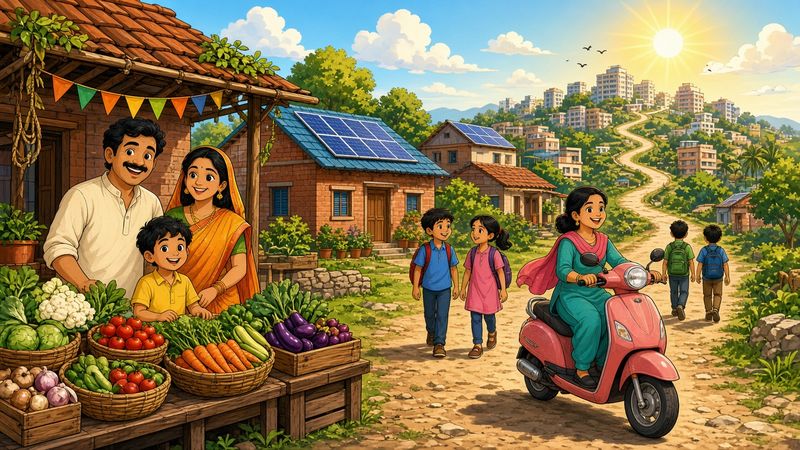
India has recorded one of the fastest declines in poverty anywhere in the world, according to the World Bank’s latest Poverty & Equity Brief for the country, published in October 2026. Between 2011 and 2023, an estimated 496 million people moved above the lower-middle-income poverty line of $4.20 a day, measured in 2021 purchasing power parity terms.
Over the same period, the share of Indians living below that line fell from 57.7 percent to 16.1 percent. Extreme poverty, defined by the World Bank as living on less than $3.00 a day, dropped even more sharply, from 27.1 percent to just 2.6 percent.
The report credits three main drivers: strong growth in household consumption, rising employment, especially among women, and expanded social transfers such as food subsidies. Rural households made faster progress than urban ones, which significantly narrowed the gap between India’s villages and its cities. Non-monetary measures point in the same direction: multidimensional poverty, which looks at health, education and living standards, has also fallen steeply since the mid-2000s.
The picture is not all rosy, however. As poverty has shrunk, it has become more concentrated among households with less education, fewer assets, unstable jobs and more dependants, and in a smaller number of regions. Wage inequality remains wide: in 2023, median earnings among the top 10 percent of workers were about 13 times those of the bottom 10 percent.
Looking ahead, the World Bank expects poverty to keep falling, but more slowly. Its projections show the share of people below $4.20 a day declining from 14.2 percent in 2026 to 12.1 percent by 2028, figures it says will be updated as new labour market and economic data arrive. For the hundreds of millions who have already crossed the line, the next challenge is staying above it and turning modest gains into lasting security.