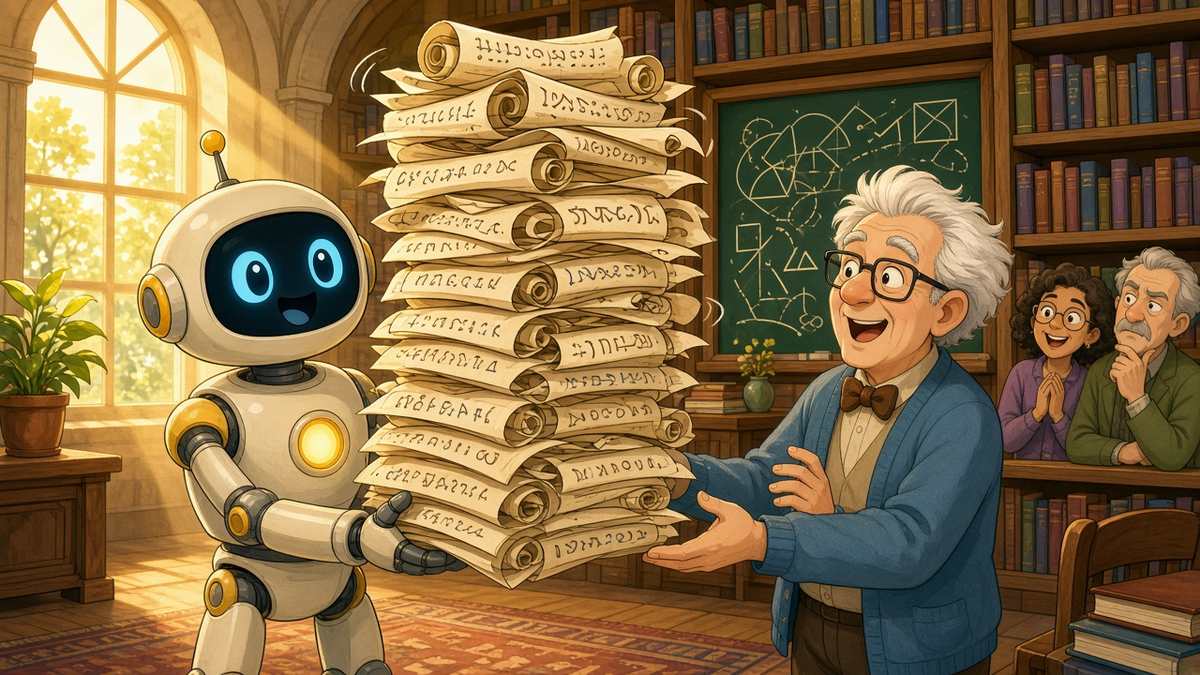
For more than 160 years, one sentence has hung over mathematics like an unclimbed summit. On 20 November 2026, Levent Alpöge, a mathematician at the AI company Anthropic, announced that he had reached the top. Working with the company’s Claude AI model, he released a proof of the Riemann Hypothesis – and, going even further, of the Generalized Riemann Hypothesis for Dirichlet L-functions. Within roughly a day, independent experts and the community behind the Lean proof assistant said they were convinced it is correct.
If that verdict holds, it would rank among the greatest results in the history of mathematics. “If true, it would, in my opinion be the greatest achievement yet by AI, and one of the greatest proofs in the history of mathematics,” Thomas Bloom of the University of Manchester told New Scientist. Rainer Dietmann of Royal Holloway, University of London, went further: “It’s like having found the Holy Grail.”
The Riemann Hypothesis was first posed in 1859 by the German mathematician Bernhard Riemann. It concerns the zeros of a function now known as the Riemann zeta function, and it predicts that they all lie on one straight line. That may sound abstract, but it sits at the heart of a very old question: how the prime numbers – numbers divisible only by 1 and themselves – are spread among all the other numbers. Primes look scattered almost at random, yet the hypothesis says a deep, hidden order governs them. Countless theorems in number theory have been written in the form “if the Riemann Hypothesis is true, then…”, which is why a proof would ripple through the entire field. The problem is also one of the seven Millennium Prize Problems of the Clay Mathematics Institute, each carrying a $1 million award.
What makes this announcement unusual is not only its subject but its form. Alpöge did not publish a classic paper of a few dozen pages. He released a formal proof written in Lean, a programming language in which every logical step must be spelled out so precisely that a computer can check it. The library is enormous: 175,187 files, about 17 million lines of code. Nobody could read that by hand. Instead, the question became whether machines – and the people who built and trust them – could vouch for it.
How a 17-million-line proof was checked in a day
Mathematicians quickly agreed on what had to be verified. Kevin Buzzard of Imperial College London, a leading advocate of computer-checked mathematics, put the first question bluntly: what exactly does the theorem in the Lean code say, and does it really match the famous statement? A program can compile perfectly and still prove something subtly different from what its author claims.
To rule that out, the Lean and Mathlib communities isolated the official statement of the Riemann Hypothesis, which already lives in Mathlib, Lean’s large shared library of mathematics, and compared it with Alpöge’s theorem using two independent tools. Both confirmed that the two statements are identical. Next came compilation. Dozens of people reported building the code without errors, and the proof was shown to rely only on Lean’s three standard axioms – no hidden assumptions slipped in.
Finally, the exported proof was run through several separate proof checkers, including Lean’s own kernel and independently written ones in other programming languages. This matters because it guards against the remote possibility that the proof exploits an undiscovered bug in a single checker. In a joint statement endorsed by the Lean FRO and the Mathlib Initiative, the communities wrote: “We have full confidence that Alpöge’s proof of the Riemann Hypothesis is correct, and we congratulate him on this achievement.”
Andrew Sutherland of the Massachusetts Institute of Technology, one of the independent checkers, was equally direct. “The Lean proof has been compiled and independently rechecked by the Lean kernel with only the three standard axioms,” he told Scientific American. “Honestly the chance that anything is fishy here is approximately zero.” At the University of Waterloo, Michael Rubinstein reported that all 175,187 modules compiled and that a second, independent kernel checked roughly 1.5 million declarations the theorems depend on, without errors.
Yet a computer-verified proof is not the same as human understanding. Knowing that something is true is different from knowing why it is true, and the “why” is what mathematicians usually care about most. Rubinstein has begun a 164-page working guide, written with the help of several AI systems, that tries to explain the argument in the style of classical number theory. It reduces the hypothesis to one key inequality between weighted sums over primes – but that central inequality is still taken from the Lean code rather than proved on paper. Turning 17 million lines into ideas that people can learn, teach and build on may take years.
The story also has an unexpected human twist. On the same day, Ravi Vakil, president of the American Mathematical Society and a professor at Stanford University, published a 940-page draft by a young Stanford postdoc, Alessandro Masullo, who reportedly attacked the problem without AI help. Stanford mathematician Brian Conrad, who has been advising Masullo, cautioned that the work is “undergoing major revision” and needs to reach a more final stage before anyone can judge it. Conrad described the choice to post it as one between “two unpalatable options”: speak now, or stay silent and publish later.
The prize question is not settled either. The Clay Institute’s rules require a solution to appear in a qualifying publication and to win general acceptance in the mathematical community over a waiting period of two years. A machine-checked library on the internet does not fit neatly into that framework, and the institute will have to decide how to handle a proof that was found with an AI system.
For many researchers, that is the larger meaning of the week. Over the past year, AI systems have chipped away at ever harder mathematical problems, but the Riemann Hypothesis was widely seen as one of the last places where human insight would stay ahead for a long time. If the verdict stands, the line between tool and collaborator in mathematics has moved decisively – and the field must now work out how to credit, explain and learn from a proof that no person could have checked alone.