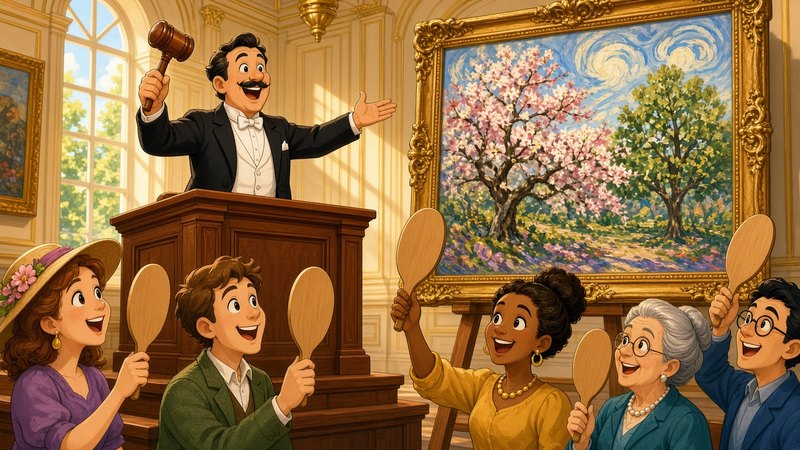
A painting of blossoming chestnut trees that Vincent van Gogh made in the last weeks of his life has become the most expensive work by the artist ever sold at auction. Châtaigniers en fleurs (1890) fetched $190.4 million including fees at Sotheby’s in New York on Wednesday night, only a day after the auction house announced a settlement that resolved a claim over the picture’s sale during the Nazi era.
The result smashes the previous Van Gogh auction record of $117.2 million, set in 2022 when Christie’s sold Verger avec cyprès (1888) from the collection of Microsoft co-founder Paul Allen. It also makes the chestnut trees the top lot of a New York auction season worth around $2 billion.
Painted in 1890, in the final two months of Van Gogh’s life, the canvas belongs to the extraordinary burst of late work that the Dutch painter produced in the French countryside. Like many pictures from that period, it shows nature in full bloom with energetic, swirling brushwork, a mood that stands in poignant contrast to the artist’s personal struggles at the time.
The auction itself was over in roughly three minutes. Auctioneer Oliver Barker opened the bidding at $135 million, and the price climbed in $5 million steps until it stalled at $165 million. A bidder in the room, who had been signalling discreetly, held the lead. Barker tried to coax one more offer from a telephone bidder, but the hammer finally fell at $165 million, which works out to $190.4 million once the buyer’s premium is added. The work had been estimated at around $180 million.
After the sale, the veteran New York dealer Bill Acquavella confirmed to Artnet News that he was the buyer. He did not say whether he had been bidding for himself or on behalf of a client. Over the decades, Acquavella has worked with some of the most prominent collectors in the world, so speculation about the painting’s eventual home is likely to continue for some time.
The outcome was never truly in doubt. Sotheby’s had guaranteed the entire group of works on offer, and the Van Gogh was backed by an irrevocable bid, meaning a buyer was lined up in advance and the painting was certain to sell. Such financial arrangements have become common at the very top of the art market, where sellers want certainty and auction houses compete fiercely for trophy consignments.
The chestnut trees were the centrepiece of a dedicated 12-lot evening sale titled “Legendary: The Blaquier-Arrieta Collection”. The pictures came from a fabled trove of Impressionist art assembled by the Argentine couple Nelly Arrieta de Blaquier, who died in 2020, and her husband Carlos Pedro Blaquier, who died in 2023. Their fortune came from the sugar-producing giant Ledesma. The couple began collecting in the 1960s and acquired the Van Gogh from the dealer Wildenstein & Co. in 1975, so the painting had stayed with the family for half a century before it returned to the market.
A last-minute settlement over the painting’s Nazi-era history
The road to the record sale was anything but smooth. Only last week, the heirs of the German Jewish publisher Samuel Fischer and his wife Hedwig came forward with a claim. They argued that the Fischer family had been forced to sell the Van Gogh in Amsterdam in 1936 because of financial pressure caused by Nazi persecution. Their Berlin lawyer, Gunnar Schnabel, demanded that Sotheby’s withdraw the painting from the sale unless it could show that the transaction had been voluntary.
Sotheby’s disputed that account. The auction house said that records from the archives of the art dealer Paul Cassirer showed the picture had been sold for 68,000 Swiss francs, roughly $22,000, in June 1936. In its view, that was a fair price for a Van Gogh at the time, and it pointed out that the painting had already been in Amsterdam for nearly three years before the sale took place.
After several dramatic days, Sotheby’s announced on Tuesday that the Blaquier-Arrieta family had reached an agreement with all the legal descendants of Hedwig and Samuel Fischer. The terms were not disclosed. Sotheby’s confirmed that the deal resolves the ownership claims and that the buyer will receive clear title to the work. The auction house also said the agreement recognises both the painting’s complicated history and the persecution the Fischer family suffered under the Nazis.
What the agreement does not do is settle the historical question at the heart of the dispute. It remains unclear whether the Fischer heirs received any financial compensation, and the settlement does not establish whether the 1936 sale took place under duress. For historians and restitution experts, that open question is a familiar one. Many sales of art by Jewish owners in the 1930s happened outside Germany and at seemingly normal prices, yet took place against a background of persecution, emigration and economic ruin that makes the idea of a “free” sale hard to judge.
Cases like this have become an increasingly important part of the art trade. Auction houses now routinely research the ownership history, or provenance, of major works from the period between 1933 and 1945. When a claim surfaces, the most common outcome is a negotiated agreement between the current owner and the heirs, often allowing a sale to go ahead while acknowledging the injustice suffered by the original owners. The chestnut trees now join a long list of masterpieces whose path to the auction room ran through such a settlement.
The record price also says something about the state of the top end of the art market. After a period in which sellers were cautious and many expensive works struggled to find buyers, a nine-figure result for a single canvas sends a strong signal that demand for rare, museum-quality pictures remains intense. Works by Van Gogh are especially scarce on the market, because most of his major paintings are already held by museums and are unlikely ever to be sold.
For Van Gogh himself, the figures are a bitter irony that is often repeated. The painter famously sold very little during his lifetime and died in July 1890, only weeks after completing pictures such as this one. More than 130 years later, a single view of chestnut trees in blossom has been valued at more than any of his works that came before it at auction.
Whether the new owner will lend the painting to exhibitions or keep it in a private collection is not yet known. What is clear is that Châtaigniers en fleurs now carries two stories with it: one about the joyful energy of spring that Van Gogh captured in his final months, and another about the dark chapter of European history that briefly threatened to keep it off the auction block.