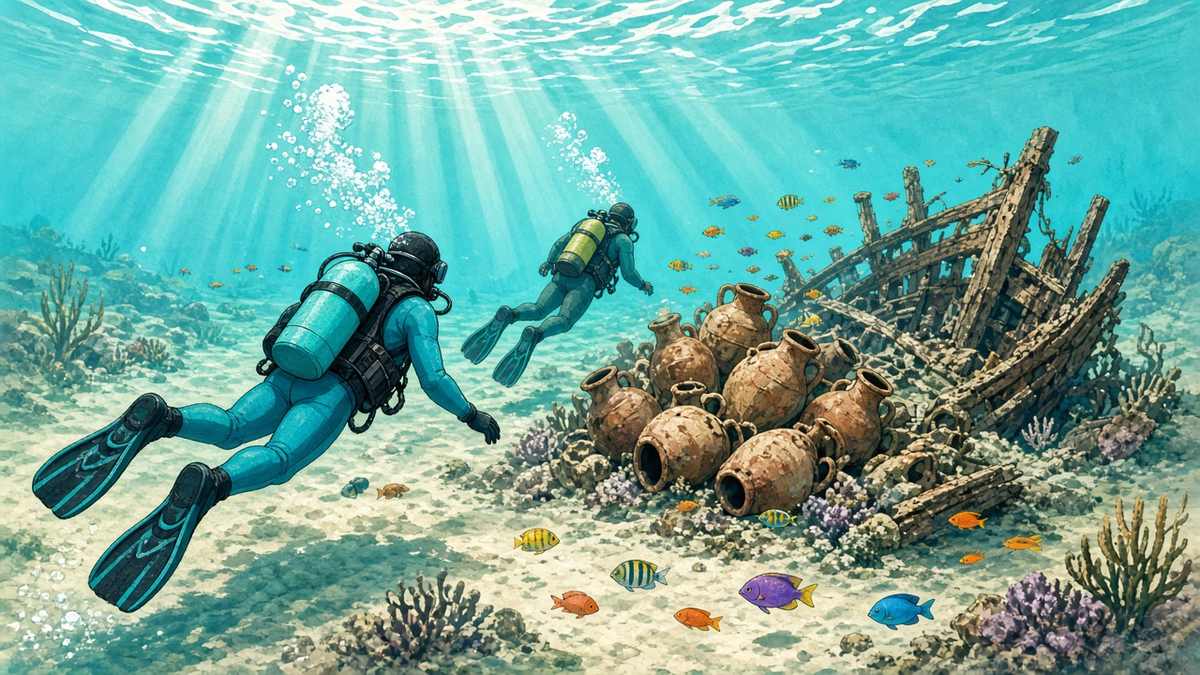
Somewhere off the southern coast of Turkey, on a sandy slope about thirty metres below the surface, a small cargo boat went down roughly four and a half thousand years ago. Nobody wrote down its name, its crew or its destination. For millennia it simply lay there, its timbers slowly dissolving until nothing of the hull was left. What stayed behind was the cargo: more than thirty large clay jars and three heavy stone anchors. Now a team of Turkish divers and international specialists says those leftovers belong to the oldest shipwreck ever found anywhere in the world.
The site lies close to Kekova Island in the province of Antalya, a stretch of coastline already famous among divers and history lovers for its sunken ruins. The expedition was led by Professor Hakan Öniz of Akdeniz University and run by the Mediterranean Archaeology Association, a group that has spent years mapping the many wrecks scattered around these rocky waters. Their verdict on the new find is bold: the vessel dates to somewhere between 4,400 and 4,700 years ago, placing it in the Early Bronze Age, in the same broad era in which Egyptian workers were raising the Great Pyramid at Giza.
That date pushes the record back by several centuries. Until now the title of oldest known wreck belonged to a site near the Greek island of Dokos, usually dated to around 4,200 years ago. The oldest wreck whose wooden hull actually survives, found in the Black Sea off Bulgaria, is much younger at roughly 2,400 years. In other words, the Kekova boat was already ancient history by the time many of the shipwrecks people picture in museum displays were even built.
Judging from how the finds are spread across the seabed, the team estimates the ship measured around ten metres from bow to stern. That is modest by later standards, more like a large fishing boat than a grand galley, but in its own day a vessel of that size could carry a valuable load along the coast. The three anchors are a nice clue to how sailors thought about risk: seafarers of the period routinely carried spares, because losing an anchor on a rocky shore could mean losing the whole ship.
How Do You Date a Ship When the Wood Is Gone?
Normally, archaeologists working on old wrecks lean heavily on radiocarbon dating, a method that measures how much of a particular form of carbon remains in once-living material such as wood, rope or food. At Kekova that tool was off the table. Every plank had long since rotted away, so there was nothing organic in the hull itself to test.
Instead the researchers turned to the jars. Clay storage vessels of this kind, known as amphorae, were the shipping containers of the ancient world, and their shapes changed over time much as bottle designs or car models do today. A trained eye can often tell which century a pot came from just by looking at its handles, its base and the way it was decorated. The Kekova jars are distinctive: each has two handles, a raised ridge running around its middle and a flat bottom. According to Öniz, that combination matches amphorae excavated in Egypt and across the Middle East that are already firmly dated to the window of 4,400 to 4,700 years ago. He has described himself as completely certain that the wreck belongs to the Early Bronze Age.
The most surprising discovery came after the jars were lifted to the surface. Dr Karin Sowada of Macquarie University in Australia, who examined the recovered vessels, found that some of the intact ones still held a thick, glossy residue on the inside. She later admitted she could hardly believe how much material had survived after so long on the seabed. That residue could turn out to be the real treasure of the excavation, because laboratory tests may reveal exactly what the ship was carrying. Olive oil, wine and tree resins are all on the list of possibilities.
Sowada is careful not to jump ahead. Jars this large were expensive, sturdy objects that were often used again and again, so the traces inside might come from an earlier load rather than the final one. Even so, any identification would add a rare piece of hard evidence about what people traded and consumed at the dawn of seaborne commerce in the Mediterranean.
The team’s working theory is that the boat set out from somewhere on the eastern shore of the Mediterranean, the region of today’s Lebanon, Syria and Israel, and was heading west. Two destinations stand out: the great city of Troy in what is now north-western Turkey, or the island of Crete, home of the Minoan civilisation. Either way, the find supports the picture of a surprisingly connected ancient world, in which goods were moving across open water long before the famous trading empires of later centuries.
It also reminds us how dangerous that trade was. The waters around Kekova are notorious for strong currents and sudden winds, and hundreds of wrecks from many eras lie on the seabed nearby. Working there is not easy for modern divers either. Because the site sits around thirty metres down, each dive was limited to roughly half an hour, so the careful job of mapping, photographing and lifting every fragment had to be spread over many short sessions.
For Öniz the work is about more than dates and pottery styles. He has spoken of being among the first people in thousands of years to touch these objects, and of thinking about everyone connected to the voyage: the potters who shaped the jars, the dock workers who carried them aboard on their shoulders, the sailors who never reached port and the families waiting for them at home. It is an unusually human way to describe a pile of clay on the seabed, but it captures why such discoveries fascinate people far beyond academic circles.
The wreck belongs to the Turkish Ministry of Culture, and Culture Minister Mehmet Nuri Ersoy has said the recovered artefacts will go on show in Antalya’s new Mediterranean Underwater Archaeology Museum, which is due to open in the coming months. Before then, conservators have their hands full. Objects that have spent millennia in salt water can crack or crumble once they dry out, so the jars are being stabilised slowly and carefully.
Meanwhile, the scientific questions keep multiplying. What exactly is that glossy residue? Were the jars made in one workshop or many? Did the ship carry anything perishable that has vanished without trace? And are there other Bronze Age wrecks still hiding on the slopes around Kekova, waiting for the next expedition? The answers may take years. For now, a small boat that sank before most of recorded history began has earned a remarkable second life as the oldest shipwreck humanity knows about.