Biology textbooks like tidy lines. Living cells sit on one side, viruses on the other, and the difference is usually explained in a few neat bullet points. A tiny organism described this week in the journal Current Biology does not care much for neat bullet points. It is a genuine cell, yet it carries fewer genes than many viruses, and it seems to have handed almost every job except reproduction over to someone else.
The microbe has been named Candidatus Sukunaarchaeum mirabile. It belongs to the archaea, the third great domain of life next to bacteria and the eukaryotes, the group that includes plants, fungi and us. Its genome is a single closed loop of 238,034 base pairs that codes for just 189 proteins. The previous record holder among archaea, Nanoarchaeum equitans, has about 490,000 base pairs, so the newcomer is roughly half its size. Typical archaea carry somewhere between half a million and almost six million base pairs.
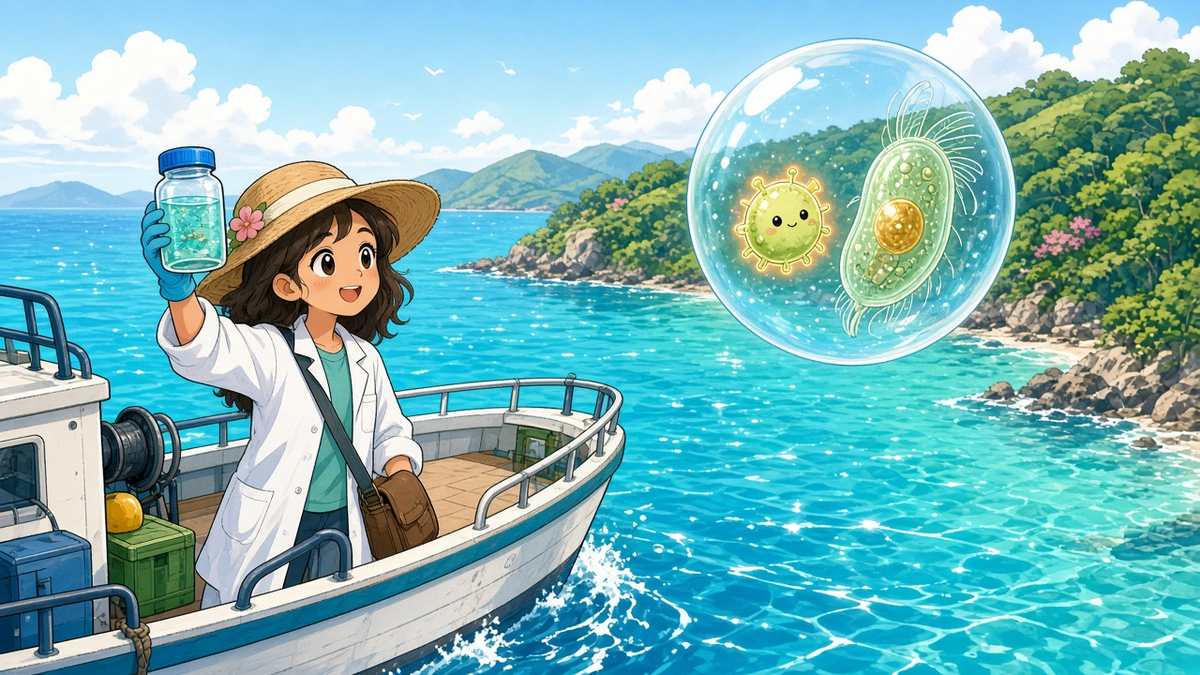
The team behind the discovery, led by evolutionary microbiologist Takuro Nakayama of the University of Tsukuba in Japan, did not go looking for a record. They were studying the genetic material inside a single plankton cell, a marine dinoflagellate called Citharistes regius collected from Pacific water near Shimoda. Among the many sequences linked to that one cell were small, odd pieces of DNA that refused to fit anywhere.
The first reaction was suspicion. A genome that small looked like a glitch in the assembly software. So the researchers read the DNA again with two completely different technologies, short-read Illumina sequencing and long-read Oxford Nanopore sequencing, and fed the results into several assembly programs. Every route ended at the same answer: one complete, gap-free circular chromosome. The consistency was what persuaded the team that they were looking at something real.
What makes the organism remarkable is not only how little it carries but what it chose to keep. More than half of its proteins are devoted to handling genetic information. It can copy its own DNA, transcribe genes into RNA and translate that RNA into proteins using its own ribosomes. It also keeps 31 transfer RNA genes, the small adaptor molecules that match each genetic code word to the right amino acid.
Almost everything else is gone. The genome shows no recognisable pathway for breaking down sugars, making the fats that form membranes, building amino acids or producing vitamins. Beyond the copying and protein-making machinery, the researchers found only a handful of extra proteins, mostly parts of transporters that presumably pull in supplies from a host, plus one that faintly resembles an enzyme of unclear purpose. Without a partner to feed it, Sukunaarchaeum would simply have nothing to live on.
Nakayama has put it plainly: metabolism is usually treated as one of the defining features of life, and this cell appears to manage almost entirely without its own. Thorsten Allers of the University of Nottingham, a co-author, has suggested the organism may be close to the minimum amount of genetic information a cell can hold while still remaining an independent cell.
Why a cell with so few genes still counts as alive
The obvious question is why this thing is not simply a virus. The answer comes down to ribosomes, the molecular factories that turn genetic instructions into proteins. In 2008 the researchers Didier Raoult and Patrick Forterre proposed sorting all biological entities into two camps: those that encode ribosomes, which are cells, and those that encode protein shells called capsids, which are viruses. A virus always needs to borrow a host’s ribosomes. Sukunaarchaeum builds its own, so by that rule it firmly stays on the cellular side.
The comparison with viruses is still striking. Giant viruses such as Mimivirus carry more than 900 protein-coding genes, and many viruses that infect bacteria encode several hundred. A free-living cell built in the lab for minimalism, the synthetic bacterium JCVI-syn3.0 unveiled by the J. Craig Venter Institute in 2016, needed 473 genes and more than 531,000 base pairs to grow on its own. Sukunaarchaeum gets by with well under half of that, but only because it outsources nearly everything. The lesson is that there is no single minimum genome for life; the floor depends on how much a cell can lean on a partner.
Other tiny genomes exist. The bacterium Carsonella ruddii, which lives inside sap-sucking insects, has an even shorter genome of around 160,000 base pairs. The difference is direction. Carsonella keeps genes that make nutrients its insect host cannot produce, so it is slowly becoming something like an organelle, the path that mitochondria and chloroplasts are thought to have taken long ago. Tim Williams of the University of Technology Sydney, who was not involved in the work, has pointed out that Sukunaarchaeum went the other way: it kept what it needs to reproduce and dropped what would make it useful to anyone else.
There is one curious exception to the general stripping down. Eight unusually large proteins of unknown function take up roughly 60,000 base pairs, nearly a quarter of the whole genome. The biggest is 4,756 amino acids long. All eight appear to sit in the cell membrane. Similar giant surface proteins in other parasitic archaea are thought to help them latch onto and invade their hosts, so the working idea is that these proteins do the same here. Puri López-García of the French National Centre for Scientific Research has raised another possibility: some of them could be metabolic enzymes that have changed so much over time that they no longer resemble any known version.
Fitting the organism into the tree of life has proved surprisingly hard. Its proteins are evolving so fast that they differ sharply from those of every other known archaeon, and different analysis methods place it in different spots. One approach puts it next to a group of small, host-dependent archaea formerly called DPANN, now known as Nanobdellati; another puts it near the Halobacteriota. Statistical testing ruled out most possible positions, and the ones left all point to a very deep, very old branch that matches no recognised phylum.
It also seems the organism is not alone. When the team searched the Tara Oceans database, a huge catalogue of genetic material collected from seas around the world, they found many related sequences forming their own distinct group, which they call the Sukuna clade. A fresh sample taken off the coast of Brazil confirmed the signal. These relatives turn up most often in particles between 5 and 20 micrometres across, larger than a free-floating archaeon, which fits the idea that they live attached to bigger microbes. Thijs Ettema of Wageningen University has suggested that such organisms may have been overlooked for years because standard software tends to throw away genomes that look too small to be complete.
Plenty remains unknown. Nobody has yet seen Sukunaarchaeum under a microscope, and it is not certain whether the dinoflagellate is its true host or just a carrier for some other partner. Nakayama’s next goal is to grow the organism in the lab and photograph it for the first time. Until then it exists for science only as a sequence, filed under accession number AP040136, and as a very good reason to ask again where life ends and something else begins.