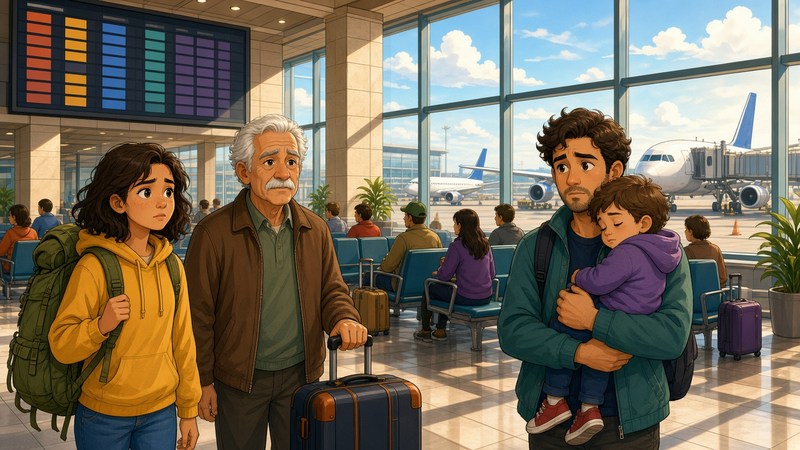
For a little more than four hours on Friday afternoon, the busiest aviation system in the world simply stopped. The US Federal Aviation Administration (FAA) ordered a nationwide ground stop after a communications failure hit air traffic control centres across the country, holding every departing domestic flight at the gate and turning airports from Boston to Seattle into crowded waiting rooms. It was the longest nationwide shutdown of US air traffic since the attacks of 11 September 2001, and although the skies reopened on Friday evening, airlines and passengers are bracing for several more days of disruption.
According to Transportation Secretary Sean Duffy, the trouble began at 3:36 p.m. Eastern Time, when air traffic control centres started to see instability in their radar and communications systems. The FAA’s announcement at 3:54 p.m. said that all flights departing within the United States would be grounded until further notice. At that moment, more than 3,500 aircraft were already in the air, according to the BBC. Some were diverted to other airports, while others continued to their destinations and landed safely. Duffy said US airspace reopened at 8:15 p.m. Eastern Time, but he warned that departures would only resume gradually. “It’s going to be slow,” he told reporters at the White House.
The numbers give a sense of the scale. Reuters, citing FlightRadar24, reported more than 6,600 cancelled and 8,600 delayed flights on Friday, with another 1,500 flights already cancelled for Sunday. The BBC, citing FlightAware, counted more than 8,500 delays and nearly 8,000 cancellations. The figures differ depending on the tracking service and the time they were taken, but every count points in the same direction: this was one of the most disruptive days in modern US aviation. Duffy said tens of thousands of passengers were stranded at airports, many of them “without any knowledge of where they’re going to sleep tonight”. Indian Express, citing CNN, put the total number of affected travellers at an estimated 1.5 million.
Behind the statistics are very ordinary human stories. Reuters spoke to a 50-year-old traveller from Pennsylvania who had been due to fly to Togo on Friday night and instead planned to spend the night at the airport before a rescheduled 6 a.m. departure. “I have to squat the night here,” he said. A British Airways passenger stuck at Newark on her way to London summed up the mood in many terminals: “I might cry at some point but not yet.” Families with small children, business travellers heading home for the weekend and international passengers with tight connections all found themselves in the same long queues at airline desks.
Old routers, new data and a $50 billion question
So what actually went wrong? According to Duffy, the culprit was not a hacker but the age of the system itself. “Our switches, our routers actually got overloaded with data and they started to give us inconsistencies in the data from those routers, and because of that we shut the system down,” he said. He described the affected equipment as “analogue telecom” and stressed that at no point did controllers completely lose radar or radio contact, which allowed thousands of planes already in the air to land safely. The decision to halt departures, in other words, was a precaution rather than the result of an emergency in the sky.
Homeland Security Secretary Markwayne Mullin said there was “zero evidence” so far that the outage was the result of a cyberattack, and Reuters reported that he also said there was no sign of a rogue AI system being involved, although investigators had not formally ruled out either possibility. “It appears this was mechanically driven, however, we’re still looking,” Mullin said, adding that the National Security Agency was working with his department on the investigation. He also dismissed any connection to the global Microsoft outage that had disrupted Outlook, Teams and other services since Thursday. According to the BBC, Mullin said that the introduction of some new technology into the old air traffic control network had overwhelmed it.
Two airline officials told Reuters that the outage appeared to affect a telecommunications network overseen by the defence and technology company L3Harris, which handles critical radio frequencies used by controllers to talk to pilots. The company did not respond to a request for comment at the time of the report.
For Duffy, the incident is proof of a problem that the aviation industry has been warning about for years. The US air traffic control system has struggled with ageing technology, equipment failures and a shortage of several thousand controllers. Duffy said the immediate fault had been fixed and that flying was safe, but he warned that without a complete overhaul, similar failures would happen again. “It’s going to continue to fail,” he said, according to the BBC. He put the cost of a new system at around $50 billion and openly blamed Congress for not funding it. “What we have is an incredibly old air traffic control system,” Duffy said. “Give us the money to fix it.” Earlier on Friday, before the outage began, the White House and the Department of Transportation had already urged lawmakers to approve $30.1 billion to upgrade the country’s airports and air traffic control infrastructure.
Aviation experts point out that Friday’s event had only one real precedent since 2001. In January 2023, a failure of the Notice to Air Missions (NOTAM) system, which publishes safety notices for pilots, forced the FAA to halt domestic departures. Dr Guy Gratton of Cranfield University told BBC Verify that the 2023 incident lasted 1 hour and 52 minutes, delayed about 9,500 flights and cancelled about 1,300. Friday’s ground stop was more than twice as long. “This looks like the worst since 9/11, but clearly not on that scale,” Gratton said.
The financial impact is likely to be felt well beyond the weekend. Reuters reported that shares of American Airlines, United Airlines and Delta Air Lines fell between 1% and 2% in after-hours trading, while JetBlue dropped about 3%. Analysts expect the knock-on effects to ripple through schedules for days, because aircraft and crews ended up in the wrong places when the system froze. American Airlines said it was prioritising flights to smaller cities and international destinations to reposition planes and crews for a faster recovery, while Delta and United said they were resuming operations and JetBlue said it would restart flights on Saturday morning.
There is one detail that will frustrate many stranded travellers: because the failure was in the FAA’s system and not caused by the airlines, US carriers are not required to compensate passengers, Reuters noted. Anyone flying in the coming days is well advised to check their booking status directly with their airline before heading to the airport, to keep an eye on rebooking options in the airline app, and to allow extra time at security and check-in as the backlog is cleared.
In the end, nobody was hurt and every plane in the sky landed safely, which is exactly what the system is designed to guarantee. But Friday’s shutdown has turned a long-running technical debate into a very visible public problem. Millions of people now know that the network guiding their flights depends partly on equipment that the government itself calls outdated. Whether that experience finally unlocks the billions needed for modernisation is a question Congress will have to answer, and travellers will be watching closely.