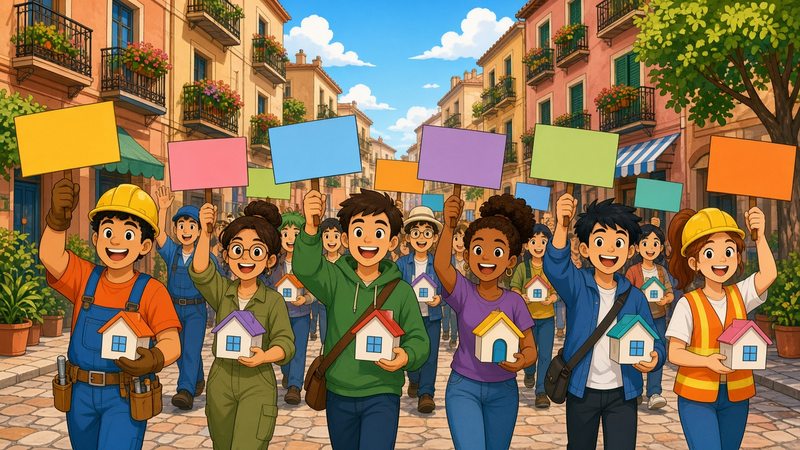
Spain came to a partial standstill on Wednesday as millions of people joined the country’s first nationwide general strike in 14 years. This time the trigger was not austerity, pensions or a labour reform, but something far more personal for many households: the cost of a roof over their heads. According to the two largest trade unions, UGT and CCOO, around four million workers took part in the 24-hour stoppage, which ran under the slogan “Salaries. Housing. Prices.”
The walkout came less than three weeks before a snap general election on November 29, turning a long-simmering social problem into one of the defining issues of the campaign. Factories, ports, markets and public transport were hit across the eurozone’s fourth-largest economy, and in the evening thousands of people marched through Madrid, Barcelona and other cities despite stormy weather.
Unusually for Spain, the strike did not start in union headquarters. It was first called by tenants’ associations, and the two big unions only threw their weight behind it later. Organisers say the movement gained momentum after the eviction of a Madrid woman, Maricarmen Abascal, whose case mobilised neighbourhoods and eventually carried the housing debate into workplaces. The unions then linked it to a broader complaint about the loss of purchasing power.
“It’s extremely important to remind people that we, the workers – who are also renters or who also pay mortgages – are the ones with the power to halt production and bring the economy to a standstill,” Sandra Mora of the Madrid Tenants’ Union told the public broadcaster RNE, as quoted by The Guardian.
Participation was strongest in industry and in coastal regions, where tourism and international demand have pushed housing costs up fastest. CCOO reported a 90% follow-up in the automotive sector and at the ports of Valencia and Algeciras, with what the unions called “total stoppages” at large plants such as Volkswagen in Navarre and SEAT in Martorell near Barcelona. The unions estimated 85% participation in the meat industry and 82% in waste collection. In services the picture was patchier: CCOO put the figure at about 61% in retail and around 25% in the financial sector.
Regionally, the unions’ first assessment put participation in Catalonia at around 84%, while Castilla-La Mancha and Extremadura were estimated at roughly 41%. The tenants’ movement said in the morning that about four million people had joined and that it expected the figure to approach five million by the end of the day. For comparison, Spain has around 23 million workers, according to the national statistics institute. These are organisers’ estimates, and official or employer figures may differ.
Why housing has become Spain’s breaking point
The anger behind the strike rests on numbers that many Spaniards feel every month. According to the Bank of Spain, the country has a shortfall of about 750,000 homes, a gap that is expected to grow to more than a million by 2028. With buying out of reach for many, demand for rentals has soared, pushing prices up further.
The Youth Council of Spain estimates that the average rent of €1,176 a month is equivalent to about 98.7% of a young person’s average monthly salary. In practice that means many people in their twenties and early thirties either share flats long into adulthood, stay with their parents, or move far away from the cities where the jobs are. Short-term holiday lets, investment buying and slow construction since the 2008 property crash are all regularly blamed for squeezing supply in popular areas.
The Tenants’ Union wants rents to come down, rental contracts to become open-ended rather than limited in time, and empty homes to be brought back onto the market. Its spokesperson, Alicia del Río, said the protest was aimed at “all governments”, as well as employers and landlords, and described the strike as the start of “a new cycle of struggles” that would continue after the election. The action was timed for the day before a housing vote in the Congress of Deputies.
For the unions, the housing crisis has become inseparable from wages. Rising rents swallow pay increases, they argue, so even workers with stable jobs feel poorer. That framing allowed the strike to unite renters, young people and industrial workers who might otherwise have little in common.
The day was largely peaceful, but not entirely. By midday, police reported 40 arrests from 476 incidents linked to the strike, including blockades of offices and industrial estates and burning rubbish containers. After the evening marches, some protesters smashed shop windows and lit bonfires, according to reports. In Madrid, CCOO’s regional leader Paloma López said around 20 union members had been injured and that the union would take police action against pickets to court, accusing officers of using batons and pepper spray. The National Police said a person detained at the Mercamadrid wholesale market had thrown a fence at an officer.
Politically, the strike lands at a delicate moment. Prime Minister Pedro Sánchez’s left-wing government is trailing in the polls ahead of the November 29 vote, and observers say the far right could make major gains. The government hopes that putting housing at the centre of the debate will mobilise its voters, while critics argue that years of rent controls and regulation have discouraged building and made the shortage worse. Whoever wins will inherit the same basic arithmetic: too few homes, too much demand, and a generation that feels locked out.
Spain is not alone. Cities from Lisbon to Amsterdam and Dublin are wrestling with similar pressures, and housing protests have spread across southern Europe in recent years. But a general strike of this size, the first since workers walked out against austerity in 2012 during the euro debt crisis, shows how far the issue has moved from a niche concern of activists to a mainstream grievance that can stop factories and ports.
Whether the strike changes policy will depend on the election and on what any new government is willing to do about supply, rents and short-term lets. For now, organisers say they have proved one thing: when renters and workers act together, the country notices. As del Río put it, the day was meant as a beginning, not an end.