






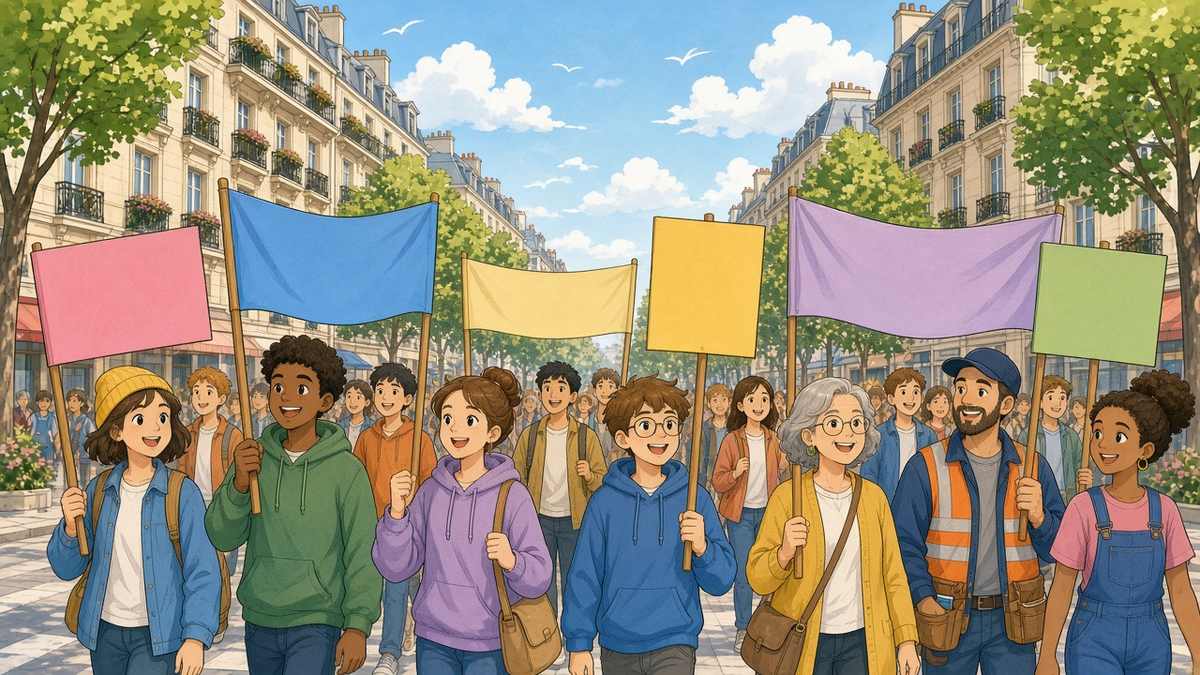
What began a few weeks ago as an argument about missing teachers and crumbling classrooms in the poorer suburbs north of Paris turned on Saturday into one of the largest and most turbulent days of protest France has seen in years. Hundreds of thousands of people marched through cities and towns across the country on October 17, angry about prices, wages and public services. By nightfall, Prime Minister Sébastien Lecornu said around 1,200 people had been arrested and roughly 150 police officers had been injured.
The numbers on the size of the day depend, as usual in France, on who is counting. Interior Minister Laurent Nuñez put turnout at about 550,000 people nationwide, including some 110,000 in Paris, spread across around 110 marches. The organisers, a coalition that included the CGT trade union and the student union Union étudiante, claimed closer to 800,000. Either figure makes it a major mobilisation, and the government itself did not try to play down the scale.
Most of those who took part did so peacefully. They walked behind banners, sang, chanted and went home. But on the margins of many marches, groups of masked people clashed with police, smashed shop windows, looted stores and set buildings and vehicles on fire. Police answered with tear gas and, in Paris, a water cannon. Lecornu, visiting officers in the centre of the capital late in the evening, said it was “a miracle” that the toll had not been higher.
The arrest count climbed sharply as the evening went on. Early in the evening the interior ministry spoke of about 400 people detained, most of them adults. A few hours later the prime minister’s figure had tripled. Nuñez blamed organised groups he linked to the radical left, along with what he called opportunistic criminals who used the cover of the crowds to plunder shops. President Emmanuel Macron said there was “no room for violence” in the country and promised that those who attacked prefectures, businesses and town halls would be prosecuted and punished.
One injury in particular has become a symbol of the day. In Saint-Étienne, a 17-year-old lost his hand during confrontations near a shopping centre, according to local officials; several French outlets reported that it was caused by a police crowd-control grenade. The young man was taken to the city’s university hospital. The incident is likely to reopen an old debate in France about the weapons police use against crowds, a debate that last flared during the yellow vest protests.
Why so many different groups came out at once
What made Saturday unusual was not only its size but its mix. The movement did not grow out of a single union call or a single law. It started in high schools. In the deprived northern suburbs of Paris, pupils began blockading their schools last month over teacher absences, overcrowded classes and run-down buildings. Images of police pushing back teenagers at school gates spread quickly on social media, and within weeks the protests had moved to other cities.
From there, other frustrations attached themselves to the student cause. Former members of the yellow vest movement, who first took to roundabouts in 2018 over fuel taxes, came back out against the high cost of living. Trade unions joined with demands on wages and pensions. Climate activists, university students and farmers added their own grievances. In Paris, organisers planned two separate routes from the Place de la République: the students headed towards the Place de la Nation, while the yellow vests and the unions marched towards the Place de Clichy. The union march passed largely without incident; the area around République, by contrast, saw running battles between black-clad groups and police, with fireworks and mortars thrown at officers.
The people interviewed by reporters on the streets described a feeling that everything is getting more expensive while services keep getting worse. One 19-year-old protester in Paris told France 24 she was marching because the cost of living was too harsh, fuel was too expensive and students were being hurt simply for asking for more teachers and decent classrooms. A mother who had come in from a western suburb with her daughter said she was protesting against “everything that’s going wrong”, especially the neglect of public services, and against policies she said favour the rich and hit the poorest hardest.
That sense of a squeeze has a global backdrop. Energy prices have been pushed up for months by the conflict around Iran and the disruption to shipping in the Strait of Hormuz, and that pressure has filtered through to fuel pumps and supermarket shelves across Europe. For many French households, the bill for a tank of petrol or a weekly shop has become the clearest everyday measure of how far their pay goes.
Outside the capital, the picture was similar on a smaller scale. In Metz, in the east, the local prefecture said about 5,200 people joined a march organised by the CGT against high prices. There, too, a peaceful demonstration was followed by damage to property and stones and fireworks thrown at police; four people were taken into custody and several officers and protesters were slightly hurt. Cities including Lyon, Rennes and Marseille also reported large marches and scattered incidents.
The political timing could hardly be more sensitive. France is about six months away from the election that will choose Macron’s successor, and the government has little room to manoeuvre. It has struggled for years to pass budgets through a divided parliament, and any promise of extra money for schools, wages or energy support will collide with pressure to bring down the deficit. At the same time, scenes of looting and burning buildings hand an argument to parties that campaign on law and order. Every camp will try to claim Saturday’s events for its own story.
For the government, the challenge is to separate two things that happened on the same day: a large and mostly peaceful movement with concrete demands, and a violent fringe that used it as cover. Leaning too hard on the violence risks looking as if it is ignoring hundreds of thousands of people who marched calmly. Ignoring the violence risks looking weak just as the campaign begins. Lecornu’s first comments focused on the injured officers; the unions, meanwhile, insisted that the real story was the turnout and the message behind it.
What happens next is uncertain. Student groups have signalled that school blockades will continue, and unions are under pressure from their members to keep the momentum going. Prosecutors will now work through more than a thousand arrests, and the investigation into the Saint-Étienne injury will be watched closely. If the government cannot offer something concrete on schools and living costs soon, France may be heading into its election season with the streets as loud as the campaign.